
6 min read
108 vistas
Southern Peru route: from Lima to Cusco overland
Going from Lima to Cusco overland is far more than a long transfer. You cross the coastal desert,...
Leer articuloThe Nazca Lines are one of Peru’s great mysteries: hundreds of giant drawings etched into the desert floor that only make real sense from the air. If you are planning a trip through the south, this guide explains what they are, how to see them, roughly what it costs and when to go.
We answer the questions travelers ask us most. Is the flight worth it? Is the viewing tower enough? Can you do a Nazca tour from Lima or Ica? Let’s take it step by step.
The Nazca Lines are a group of geoglyphs: drawings and lines made directly on the ground of a desert plain between the towns of Nazca and Palpa, in Peru’s Ica region. UNESCO listed them as a World Heritage Site in 1994.
They are attributed mainly to the Nazca culture, which lived here some two thousand years ago (UNESCO dates the lines roughly between 500 BC and AD 500). To make them, people removed the dark stones covering the surface and exposed the lighter ground beneath. The extremely dry climate, with almost no wind or rain, explains why they have survived.
There are animals and plants, but also straight lines running several kilometers, trapezoids and spirals. Scale is the key point: many designs are tens or hundreds of meters long, so on foot you barely notice them.
Why were they made? There is no single answer. The most widely accepted ideas point to an astronomical calendar (the theory researcher Maria Reiche defended for decades), to ritual paths used to ask for water and fertility in an arid land, or to a mix of both. Alien theories, on the other hand, have no scientific support.


A typical flight lets you spot between 12 and 13 figures. Sizes are approximate and vary by source:
Each pilot follows a slightly different route and points out every figure, telling you which side to look. A useful trick: have your camera ready as soon as you hear “on the right” or “on the left.”
There are two ways to see the Nazca Lines, and they are not equivalent.
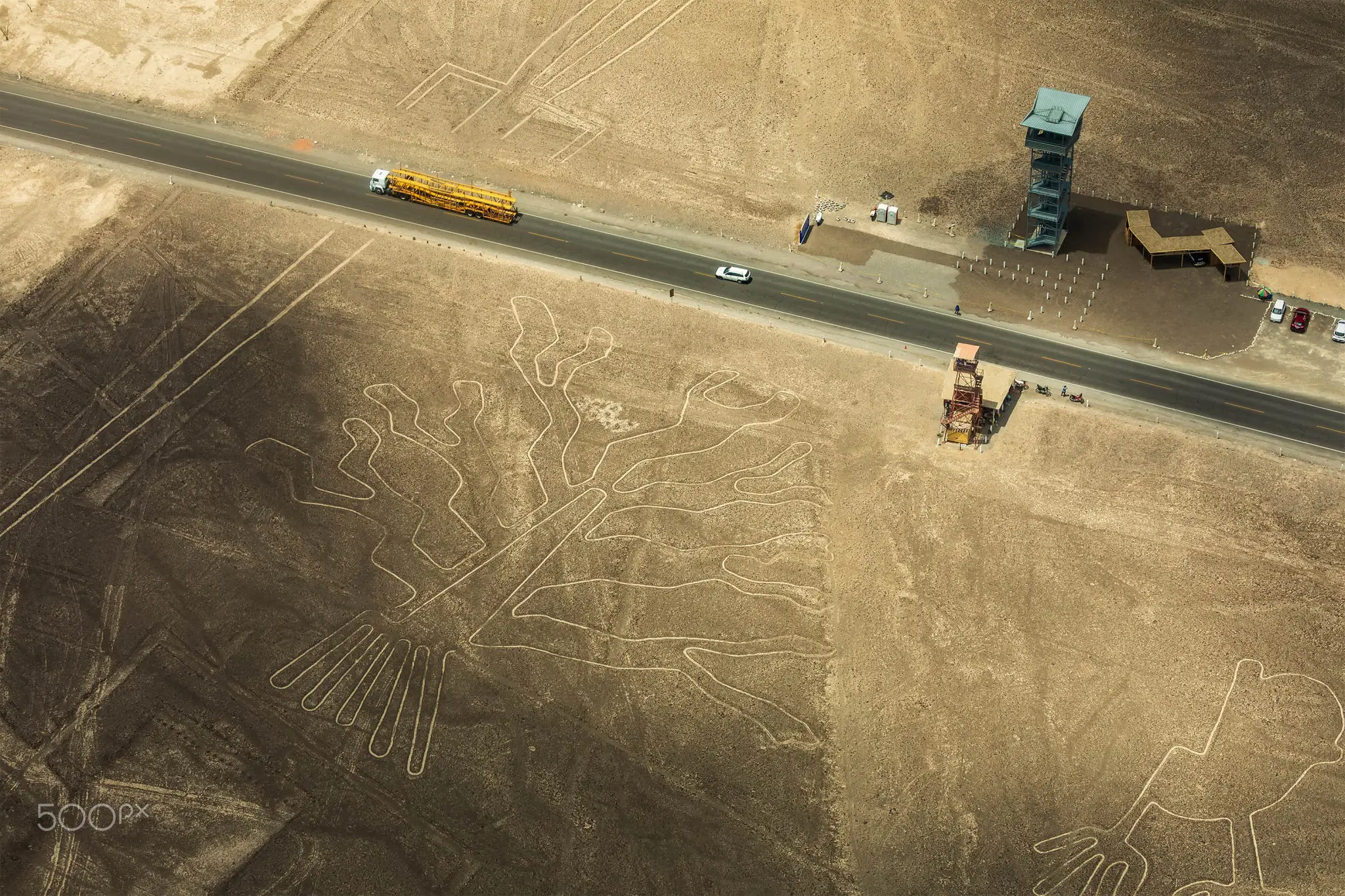
The flight is the full experience: small planes with few passengers that circle each figure so everyone gets a good look. The viewing tower is a metal platform beside the Pan-American Highway South, a few kilometers from the town of Nazca, where you see only a couple of figures from a few meters up.
| Flight | Viewing tower | |
|---|---|---|
| What you see | 12 or 13 figures and lines | 2 or 3 figures (tree, hands) |
| Perspective | Aerial, low altitude | From a tower a few meters high |
| Duration | 30 to 40 minutes in the air | 15 to 30 minutes |
| Cost | Medium to high | Very low |
| Best for | The full experience and photos | Tight budgets or non-flyers |
Our honest advice: if your budget allows, take the flight. If you get motion sickness easily, are nervous about small planes or simply cannot stretch the budget, the tower is a valid alternative, although the view is far more limited.
Flights leave from three places. Which one suits you depends on your time and where you sleep.
From Nazca. The most direct option. You take off from the town’s airfield and reach the figures within minutes, so almost all your airtime is spent over the lines. If you are already passing through town, this is the best choice.
From Ica. Some operators run flights departing from Ica. The trip out to the lines adds flying time, so the experience is longer and usually costs more. It makes sense if you are staying in the city or in Ica and Huacachina and want to skip the road transfer to Nazca.
From Pisco. Similar to Ica: part of the route is simply getting there by air. It works well if you are coming from Paracas and want to save hours on the bus.
What about a Nazca tour from Lima or Ica? Nazca is about 440 km from Lima, roughly 7 to 8 hours by road each way. Doing it as a same-day round trip by land is exhausting. The comfortable way is to spend a night in Ica or Nazca, or to book a tour that includes a flight. From Ica the road trip is much shorter, around 2 to 2.5 hours.
Prices change with the season, the operator and the type of aircraft. These ranges are only a guide to help you budget:
| Option | Approximate duration | Approximate price per person |
|---|---|---|
| Flight from Nazca | 30 to 40 min in the air; 1.5 to 2 h with check-in and waiting | Between 100 and 200 USD |
| Flight from Ica or Pisco | Longer than from Nazca; varies by operator and route | Above the Nazca flight |
| Viewing tower | 15 to 30 minutes | A few soles |
On top of the flight, an airfield fee is usually paid separately. Always ask whether it is included and confirm the final price when you book.
In high season (June to August and holidays) it pays to book ahead. Flights go when the plane fills up and the weather allows, so do not count on an exact departure time.


Fly early. In the morning the air is steadier and there is less turbulence. From midday on, desert heat creates rising air currents that make the flight bumpier, and anyone prone to motion sickness will notice.
The area is dry and mostly clear nearly all year, so there is no “bad” season. What can cancel a flight is wind or haze, so avoid leaving Nazca for your last day and keep some slack in case you need to reschedule.
A few practical tips:
In the air, a good photo depends more on quick framing than on gear. Breathe, look out the window and enjoy it.
Nazca is a natural stop on the southern Peru route, the circuit linking Lima, the Ica coast, Arequipa and Cusco. The usual order looks like this:
One day is enough for Nazca: the morning for the flight, and the rest of the day to rest or visit local museums and archaeological sites.
If you would rather not worry about transfers, schedules and bookings, add Nazca to your southern route with us. We tailor the itinerary and coordinate the flight with trusted operators. You can see all the options in our Peru packages.
También te puede interesar
Going from Lima to Cusco overland is far more than a long transfer. You cross the coastal desert,...
Leer articulo
Paracas is the gateway to one of the most accessible wildlife shows in Peru. In a single morning...
Leer articulo
For a first trip to Peru, seven days can cover Cusco, the Sacred Valley, and Machu Picchu. Nine...
Leer articulo
Knowing the best time to visit Ica will help you enjoy the desert, the Huacachina oasis, dune buggy...
Leer articulo
Knowing what to do in Huacachina will help you make the most of one of the most unique...
Leer articulo
Hello, bloggers. Traveling from Lima to Ica is one of the most popular routes for visitors exploring the...
Leer articulo
Traveling to Ica is not just about reaching a destination. It’s about stepping into a completely different rhythm....
Leer articulo