8 min read
40 vistas
Cusco Tourist Ticket: What It Includes
If you’re planning your visit to Cusco, you’ve likely come across the term “Tourist Ticket” more than once....
Leer articuloIn the Sacred Valley of the Incas, just a short distance from one another, sit two of the most photogenic and fascinating sites in the entire Cusco region: Moray, with its mysterious circular terraces that look like an amphitheater carved into the earth, and the Maras Salt Mines, thousands of brilliant white salt pans cascading down a mountainside. Both destinations are usually visited together in a single day, and in this guide we’ll cover everything you need to know to plan your visit.
Moray and Maras are two sites located relatively close to each other in the Sacred Valley, though they have completely different origins and functions. Moray is an Inca archaeological complex formed by concentric circular terraces, arranged in a stepped pattern within natural depressions in the terrain, which many researchers consider an experimental agricultural center used by the Incas to test the cultivation of different species across distinct microclimates.
The Maras Salt Mines, on the other hand, are a system of over three thousand salt evaporation pools, built into a mountainside and fed by an underground saltwater spring. This salt-mining system has pre-Inca origins, though it was refined and expanded during Inca times, and remarkably remains in operation to this day, with local families continuing to work the pools using techniques passed down through generations.
Although not directly connected historically or functionally, both sites sit at a reasonable distance from each other, which is why most tours combine them into a single visit, usually alongside other points of interest in the Sacred Valley.
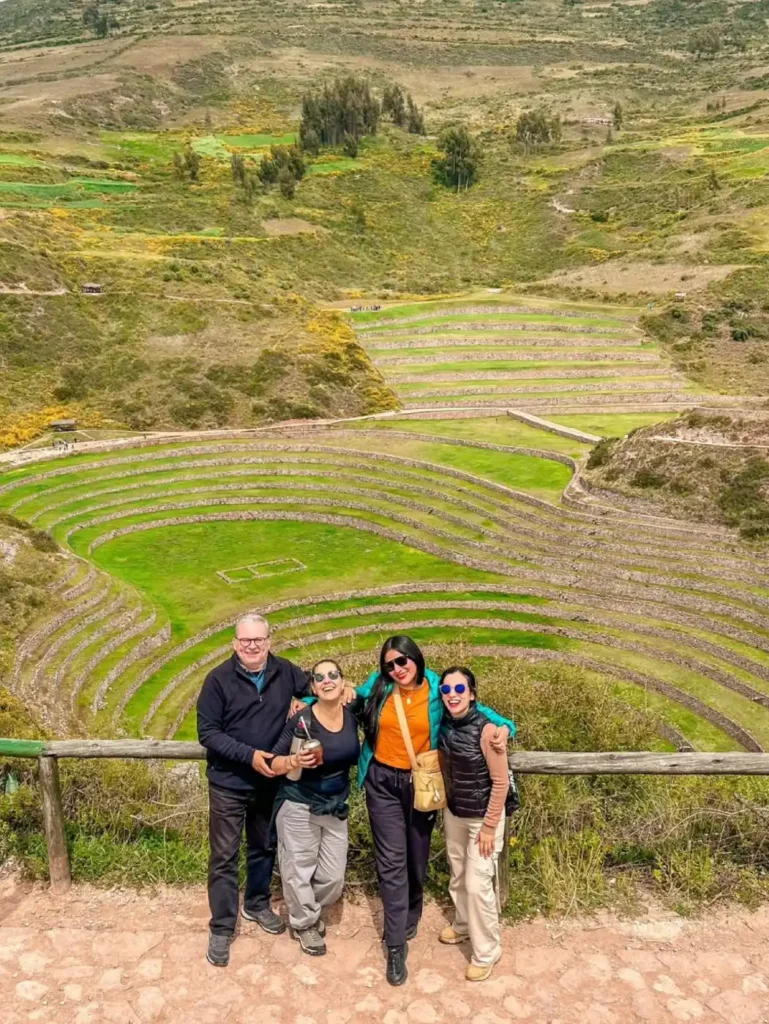
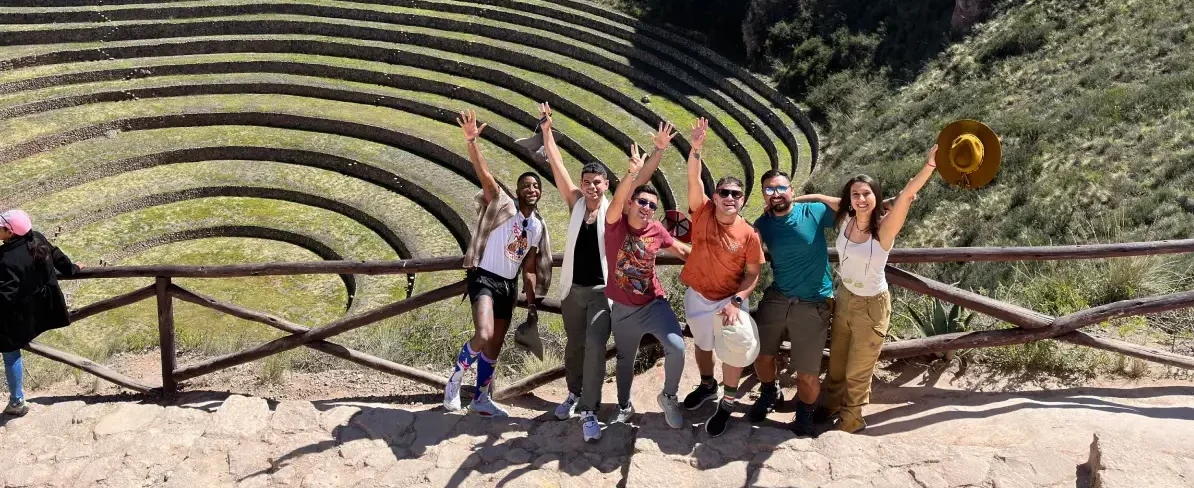
What makes Moray so visually striking is the near-perfect geometry of its circular terraces, arranged in concentric rings that descend as much as 30 m (98 ft) deep in some of the site’s main sectors. From the upper rim, the view of these stepped rings creates an almost hypnotic effect, and it’s easy to see why this place has become so popular among photographers.
But beyond its aesthetic value, Moray holds a fascinating scientific and agricultural significance. Studies conducted at the site have shown that the temperature difference between the top and bottom of each set of terraces can be as much as 15°C (27°F), which would have allowed the Incas to recreate different microclimates within a relatively compact space. This feature suggests Moray functioned as a kind of agricultural laboratory, where seeds and plant varieties were tested under different climate conditions, perhaps with the goal of adapting crops to the empire’s various altitudes.
The site features several sets of circular terraces, the largest and best-known being the one visible from the main access viewpoint. Touring the full site, including a descent into the interior of the largest terraces (where regulations allow it), usually takes 1 to 1.5 hours.
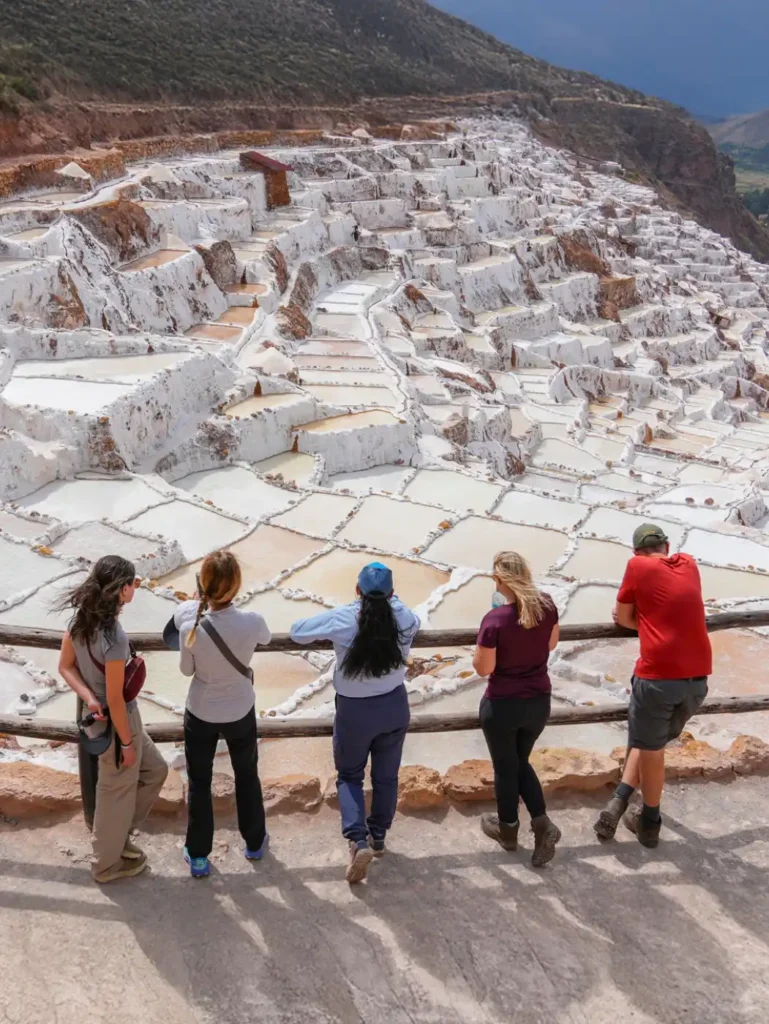
A few kilometers from Moray, the Maras Salt Mines offer a completely different visual contrast: instead of the typical green and ochre tones of the Andean landscape, here you’ll find thousands of brilliant white rectangular pools, arranged in stepped terraces covering the entire mountainside, fed by a naturally occurring saltwater spring rising from underground.
The salt-extraction process remains, to a large extent, the same as it was centuries ago: salt water is channeled into individual pools, where it’s left to evaporate under the sun until only crystallized salt remains, which is then hand-harvested by local workers. Each pool is owned or managed by a specific family from the area, and salt mining remains an important source of income for the local community to this day.
Walking along the paths bordering the salt pans lets you observe this process up close, as well as notice the surprising range of hues the salt can take on depending on its purity level and the stage of the evaporation process it’s in. At some of the shops near the entrance, you can buy Maras salt in various forms, a popular souvenir among visitors.
Touring the salt mines is relatively quick, generally 45 minutes to 1 hour, walking along the paths that border the complex from the upper viewpoint down to the lower section.
Both Moray and the Maras Salt Mines sit roughly 1 to 1.5 hours from Cusco by vehicle, though the specific route and visiting order can vary depending on the operator. The most common way to see both sites is through a half-day or full-day tour that combines them, usually departing from Cusco in the morning and visiting one and then the other, since the distance between the two points is relatively short (about 30-40 minutes by vehicle).
It’s also common for these two sites to be included as part of a broader Sacred Valley tour, combined with other destinations like Ollantaytambo or Chinchero, especially if you have a full day to explore the region. If you prefer more schedule flexibility, there’s also the option of hiring private transportation to visit Moray and Maras at your own pace, without the constraints of a group tour.
It’s worth noting that access to both sites requires paying an individual entrance fee (in Moray’s case, this is usually included within Cusco’s general tourist ticket, while the Maras Salt Mines generally have a separate entrance fee, managed by the local community).
To make the most of the photographic light and avoid peak tourist hours, we recommend visiting both Moray and the Maras Salt Mines early in the morning, ideally before 10 am. Morning light tends to be softer and more flattering for photography, especially at the salt mines, where the contrast between the white salt and the mountain’s tones is better appreciated without the harsh glare of the midday sun.
As for the time of year, the dry season (May to September) offers the best overall conditions, with clearer skies and a lower chance of rain, though both sites can be visited year-round without major issues, since they don’t involve physically demanding hikes or depend as heavily on weather as other mountain excursions in the region.
Before your visit to Moray and the Maras Salt Mines, keep these practical tips in mind:
Moray and the Maras Salt Mines represent two fascinating faces of human ingenuity in the Andean region: on one hand, Inca agricultural experimentation reflected in nearly hypnotic circular terraces, and on the other, a salt-mining tradition that has survived intact for centuries. Visiting both in a single day is one of the best ways to round out your Sacred Valley route with landscapes you won’t find anywhere else in the world.
Ready to discover these two Sacred Valley treasures? Add Maras and Moray to your trip through our Peru packages, and we’ll help you coordinate this visit alongside the rest of your itinerary in the region.
También te puede interesar
If you’re planning your visit to Cusco, you’ve likely come across the term “Tourist Ticket” more than once....
Leer articulo
Just a few minutes from Cusco’s Plaza de Armas, on the hills overlooking the city from above, sits...
Leer articulo
The Uros Islands Peru are one of the most unique cultural experiences on Lake Titicaca. Located near the...
Leer articulo